


Pressure Gauges for Reliable Measurements
Find the optimal pressure gauge for your application using the filtering options below. If you need help, we're here to guide you with our pressure gauge selection tool.
Use Gauge Selection ToolPressure Gauges
Ashcroft® pressure gauges are supplied in a wide variety of sizes, accuracies and ranges to fit nearly any budget and application requirement.
Showing 1-12 of 5 products
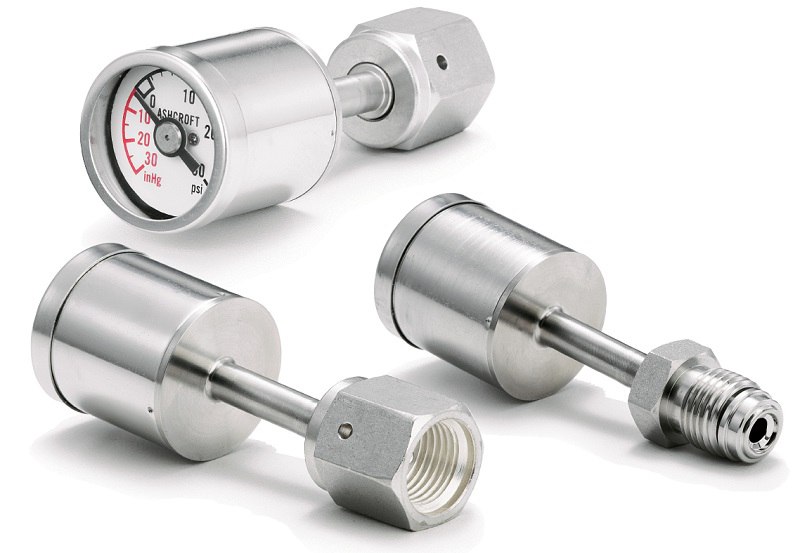
HPX Miniature High Purity Pressure Gauge – 28 mm
The Ashcroft® 28mm HPX miniature high purity pressure gauge offers exceptional performance and reliability for ultra high-purity gas delivery systems within the semiconductor and electronic...
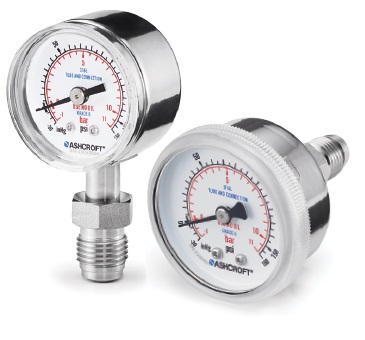
HPX High-Purity Pressure Gauges – 40 mm & 50 mm
The Ashcroft® 40 mm/50 mm HPX high purity pressure gauges are ultrasonically cleaned to provide exceptional quality and reliability in ultra high-purity gas delivery systems....
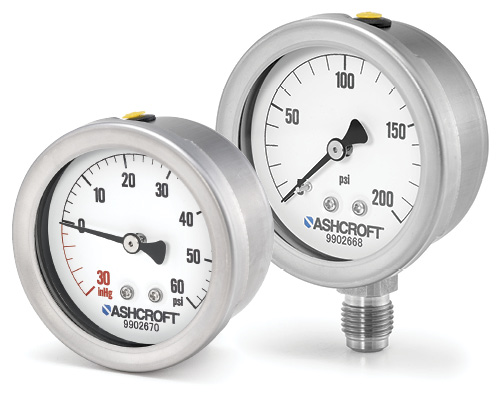
HPX High-Purity Pressure Gauge – 63 mm
The Ashcroft® 63 mm HPX high purity pressure gauge is ultrasonically cleaned to provide exceptional quality and reliability in ultra high-purity gas delivery systems. Its...
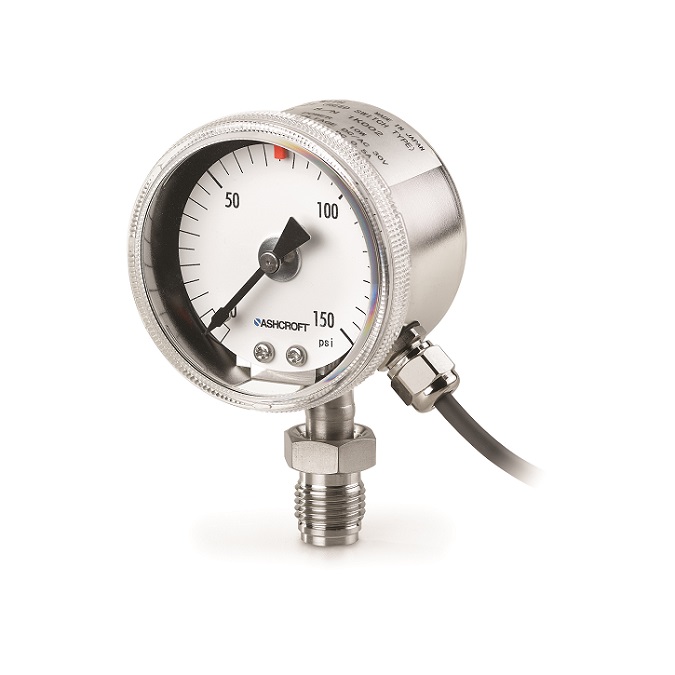
HPS High Purity Pressure Gauge with Reed Switch
The Ashcroft® 50 mm HPS high-purity pressure gauges with Reed Switch are ultrasonically cleaned to provide exceptional quality and reliability in ultra-high-purity gas delivery systems....
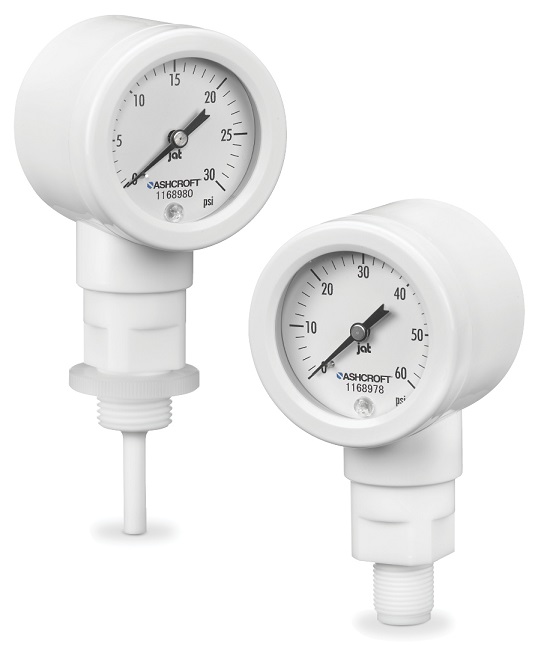

HPT – 63 mm Pressure Gauge
The Ashcroft® 63 mm HPT anti-corrosion pressure gauge offers exceptional performance and reliability for chemical delivery systems within the semiconductor and electronic fabrication industries. Nitrogen...Types of Pressure Gauges
Ashcroft offers a broad range of pressure gauges engineered for accuracy, durability and reliability across industrial, commercial, and OEM applications.
- Bourdon Tube Pressure Gauges – Designed to provide mechanical pressure measurement for general‑purpose, medium‑ to high‑pressure applications such as industrial equipment and hydraulic systems.
- Diaphragm Pressure Gauges – Designed to measure low pressures and isolate corrosive or sanitary media in process and chemical applications.
- Differential Pressure Gauges – Designed to measure pressure differences for flow, level and filter monitoring in process systems.
- Liquid‑Filled Pressure Gauges – Designed to dampen vibration and pulsation in demanding environments such as pumps, compressors and outdoor installations.
- Digital Pressure Gauges – Designed to deliver high‑accuracy electronic pressure measurement for testing, monitoring and field verification.
- Vacuum & Compound Gauges – Designed to measure vacuum or combined vacuum and positive pressure in HVAC, refrigeration and process applications.
- Sanitary Pressure Gauges – Designed to meet hygienic requirements in food, beverage and pharmaceutical processes.
- Test Pressure Gauges – Designed to support calibration, testing and verification in maintenance and quality applications.
Industry Applications Where Pressure Gauges are Used
Ashcroft pressure gauges are used in a wide range of industries, delivering accurate and reliable pressure measurement in demanding environments.
- Oil & Gas – Used in upstream, midstream, and downstream pressure measurement applications.
- Chemical & Petrochemical – Used in corrosive and high‑temperature process environments.
- Power Generation – Used in steam, turbine, and auxiliary systems.
- Water & Wastewater – Used in treatment, pumping, and distribution systems.
- Food & Beverage – Used in sanitary process applications requiring hygienic pressure measurement.
- Pharmaceutical & Life Sciences – Used in cleanroom, validated, and sanitary environments.
- HVAC & Refrigeration – Used in climate control and cooling systems, including ammonia applications.
- Manufacturing & OEM – Used in equipment integration, automation, and general industrial applications.
- High Purity & Semiconductor – Used in ultra‑clean processes requiring contamination‑free pressure measurement.
- Hydrogen & Alternative Energy – Used in high‑pressure and emerging energy applications.
Frequently Asked Questions for Pressure Gauges
Can I order non-standard ranges for digital gauges?
Depends on the product family. Precision: no. Industrial: maybe. DG25: Yes. If range isn’t already set up, there will be a set-up fee for a new range.
What is the gauge storage and shelf life for Ashcroft® gauges?
Ashcroft gauges should be stored indoors in a clean, dry, well-ventilated area protected from physical damage and shock. Storage temperature should not exceed the temperature limits shown below:
| STORAGE TEMPERATURE LIMITS | |
| Dry | –40/250 °F (–40/121 °C) |
| PLUS! | –40/250 °F (–40/121 °C) |
| LF (Glycerin) | 0/150 °F (–18/66°C) |
| (Silicone) | –40/150 °F (–40/66 °C) |
| Halocarbon | –40/150 °F (–40/66 °C) |
If the instruments are determined to fit and the storage recommendations have been adhered to, Ashcroft® will honor its warranty as detailed in the Ashcroft® Terms of Sale.
Does Ashcroft have NACE compliant instruments?
Yes, there are a number of Ashcroft pressure gauges, diaphragm seals, switches, transducers and thermowells that are NACE compliant. See the whole list of compliant products here.
How often does a gauge need to be calibrated?
This is quite subjective and depends upon the severity of the indicated pressure. The environmental limitations for the pressure gauge series should be observed in all cases. Gauges used in situations outside these requirements may result in inaccuracies, premature wear and/or failure of the gauge and would require additional maintenance. The frequency of calibration, therefore, is best left to the user to determine.
Does PLUS!™ Performance affect accuracy?
No. The only difference is that the response time is similar to liquid filled gauges.
What is the difference between the proof pressure and burst pressure?
Proof pressure is the maximum pressure a gauge can withstand without evidence of change in accuracy. Burst pressure is the maximum pressure above which the pressure assembly may no longer hold pressure.
Related Resources
Identifying Gauge Performance Gaps Through a Plantwide Instrument Audit (resource)
How to Choose a Low-Pressure Diaphragm Gauge (resource)
Improving Pressure Gauge Reliability in Severe Process Applications (resource)
Improving Reliability in Mobile Hydrogen Systems with High-Pressure Instrumentation (resource)
When Do You Need RoHS and REACH for Pressure Instruments? (resource)
Differential Pressure Monitoring for Large-Scale Printer Application (resource)
Product Comparison: Industrial Pressure Gauges for General and Harsh Applications (resource)
Food and Beverage Instrumentation: Understanding NSF, 3-A and FDA Requirements (resource)
Why Material Compatibility Matters When Replacing Pressure Instrumentation (resource)
What's the Difference Between NIST and ISO/IEC 17025 Calibration? (resource)
Why Should My Pressure Gauge Pointer be in the Center of the Scale? (resource)
Product Review: 1209 XRA vs T6500 XRA Pressure Gauges for Overpressure Applications (resource)
Why Use a Flush Connection in Sanitary Processes? (resource)
What is a Bellow Gauge? (resource)
Choosing Assemblies for Low-Pressure Applications (resource)
Factors for Choosing a Process Connection for Your Application (resource)
Are Pressure Gauges Repairable? (resource)
Why Use Tri-Clamp Fittings for Hygienic Applications? (resource)
How to Select the Right Pressure Gauge Pointer Type? (resource)
What Is a Zero Box vs. a Dial Pin on a Pressure Gauge - and Why It Matters (resource)
9 Question Checklist for Pressure & Temperature Instruments (resource)
CIP, SIP Autoclaving: A Comparative Review of Pressure Gauge Cleaning Technologies (resource)
10 Question Checklist for your OEM Solutions (resource)
Protecting Monel Pressure Gauges from Stress Corrosion Cracking in Hydrofluoric Applications (resource)
Ingress Protection and NEMA Ratings for Pressure Gauges (resource)
Ready to solve your pressure and temperature challenges?
Whether you need to safeguard critical processes, meet compliance standards or reduce downtime, we’re here to help. Reach out to learn how Ashcroft solutions can keep your business protected and efficient.